The Game
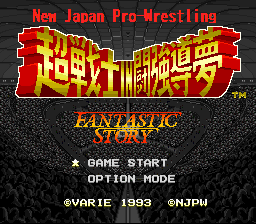
Shin Nippon Pro Wrestling: Chou Senshi in Tokyo Dome (新日本プロレス 超戦士闘強導夢, subtitled Fantastic Story) is a pro wrestling game for the Super Famicom, made by Varie and released in Japan only, in 1993 (the title screen reads "©VARIE 1993 ©NJPW"). The cartridge's opening screen credits New Japan Pro-Wrestling as authorizing the game and Seiji Sakaguchi as supervisor. The logo's last word, 超戦士闘強導夢, is a pun on "Tokyo Dome"; the English patch keeps it as it is.
The game is mostly English already, so the patch translates what was Japanese: the wrestlers' comments after a match, the mode descriptions, the names on the select and VS screens, the match-length line, the corner announcement before a match and the opening screens. This guide explains what the game does. It explains the grappling exchange in detail (Grappling) but does not yet list every move; see Contributing.
- Ten wrestlers. The roster is ten real New Japan wrestlers of the time, with no hidden extra slot.
- Two modes. A knockout tournament and a versus mode for one to four players: see Modes.
- Grappling decides throws. The tie-up is won by pressing once at the right moment, and the game level changes how fast the CPU acts: Grappling.
- Talking winners and losers. After a match the wrestler comments in a text box: After the match.
Modes
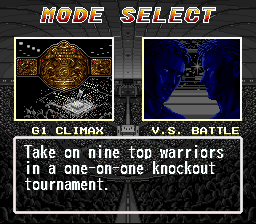
| Mode | What it is |
|---|---|
| G1 CLIMAX | A one-on-one knockout tournament against nine top warriors. |
| V.S. BATTLE | Fight the computer or friends in single or tag matches. |
The mode names are pictures in the game and were already English; the descriptions in the box are what the patch translates.
G1 Climax
You pick a wrestler and take on the nine others one-on-one in a winners-advance tournament according to the mode's description. Winning the tournament has its own comment for every wrestler: see After the match.
V.S. Battle
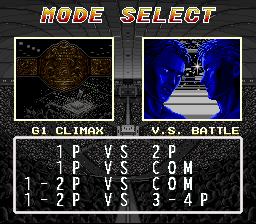
First choose SINGLE MATCH or TAG MATCH, then who plays whom.
| Match | Choices |
|---|---|
| Single match | 1P VS COM, 1P VS 2P |
| Tag match | 1P VS 2P, 1P VS COM, 1-2P VS COM, 1-2P VS 3-4P |
"1-2P VS 3-4P" needs four controllers, which means a Super Multitap in the second controller port. The cartridge checks both ports when it starts; see the multitap error screen.
Controls
You play with a standard Super Famicom pad. One wrestler is yours, and what the face buttons do depends on the situation: the same button strikes when you are standing, throws when you are locked up and stomps when your opponent is down. Everything here was watched with Jushin Liger against an idle Great Muta and read from the game's code. The other nine wrestlers share the structure, but their own moves have not been checked.
Your first match
- On the mode select, pick V.S. BATTLE, then SINGLE MATCH and 1P VS COM.
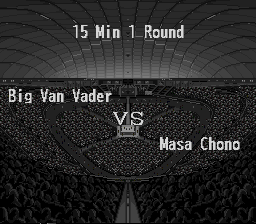
- Choose your wrestler, then the computer's. The VS screen shows the time limit: 15 minutes, 1 round, by default.
- Walk up to him and strike with A or B. Your wrestler always faces him.
- Press X when close to lock up, then press once at the right moment: see Grappling.
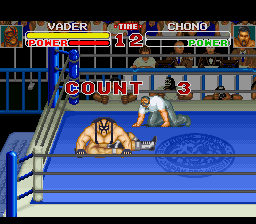
- When he is down, press L or R to cover him. The referee counts to 3 and BLUE WIN or RED WIN shows. Player 1 is the blue corner.
Moving
Walk
Any of eight directions. Up is toward the back ropes, down toward the front. Walking away backs you up: you keep facing him.
Run
Tap left or right, release, tap again and hold. Pressing the opposite direction stops you. Run into a standing opponent and you both fall, and it works for him too.
Bounce off the ropes
Run into the ropes and you rebound the other way at speed.
Leave and enter the ring
At the side ropes, hold left or right and press X to climb out. The same toward the ring climbs back in.
Climb the turnbuckle
Walk into the back-right corner. The left corners did not climb in the test, and Big Van Vader and S. Hashimoto never climb. Up there you leave only with a dive.
Tag
In a tag match, press X and left or right at your corner to tag your partner in. Not tried in game.
What the face buttons do
The game picks one of eight sets of four moves for each wrestler from what is going on. These are Liger's, described by how they look, because the game has no move names. X is the same for all ten wrestlers; A, B and Y differ for each. Moves that need POWER need the gauge at least 3/8 full; with less, the game does a weaker move instead. A grab only starts when you are close: within about 64 pixels sideways and 32 deep.
Standing
Nothing special is happening.
- AQuick strike
- BHeavier strike
- XGrab, when close
- YLong lunging attack
Locked up
From phase 3 of the tie-up. See Grappling.
- AThrow
- BVertical suplex-type throw
- XIrish whip
- YStrongest throw (needs POWER)
Running
Double-tap left or right.
- ARunning attack that pushes him back
- BRunning attack that knocks him down
- XNothing: you run into him
- YFlying attack that knocks him down
Opponent down
You are close to him.
- AStomp
- BJumping drop
- XPull him up, dazed
- YSubmission hold
Dazed, facing him
After you pull him up.
- AQuick strike
- BHeavier strike
- XGrab
- YJumping kick
Dazed, from behind
You and he face the same way.
- AQuick strike
- BHeavier strike
- XGrab
- YBridging back suplex
He is running
Running or rebounding off the ropes.
- AQuick strike
- BHeavier strike
- XNothing
- YCounter: catch him, drive him down
On the turnbuckle
Walk into the back-right corner.
- AFlying body attack
- BFlying body attack
- XNothing
- YBig flipping dive (needs POWER)
A turn in the ring
Most exchanges follow one path. Each step opens the next.
Each step was seen on its own; the whole chain in one go was not.
Pins and submissions
L or R with a downed opponent close drops your wrestler onto him and the referee counts. Anywhere else those buttons do nothing. COUNT 1 comes about 1.25 seconds after the press and each count after that about 1.1 seconds later.
The opponent kicks out at once if he has any health left. A pin only works once his health is 0, and even then he can escape if his recovery pool is still high and he struggles.
On some throws, pressing L or R on one exact frame turns the throw straight into a pin. Liger, Hase, Muta, Vader, Norton, Fujinami and Hashimoto have such a throw; Choshu, Halme and Chono do not.
Hold a direction and press A, B, X or Y over and over. With health at 0 and the recovery pool nearly full, a defender who did this kicked out just before the count of 3. With the pool lower he did not.
A submission is a different ending: Y on a downed opponent puts on a hold, and he gives up only if his health, POWER and recovery pool are all out. With health left he escapes.
Menus and Messages
The menus are driven by the directional pad, with Start and A to confirm: the menu code reads only those buttons and the pad's directions.
Messages (mode descriptions and post-match comments) are typed out one letter at a time, four frames per letter in the English build (eight in the original, which draws bigger letters). Press A or B to skip ahead.
Option Mode
The title screen's OPTION MODE sets how matches run. Up and down choose a line, left and right change the value (it does not wrap round), and EXIT leaves. The options survive a reset.
| Option | Values | Default | What it does |
|---|---|---|---|
| GAME LEVEL | EASY, NORMAL, HARD | NORMAL | How often the computer grabs and throws; nothing else. See The CPU. |
| CONTINUE | 3, 4, 5 | 3 | Presumably the continues in G1 Climax |
| ROUND | 1, 3 | 1 | Shown on the VS screen as "1 Round". Three rounds not tried |
| TIME | 5, 10, 15, 45, 60, unlimited | 15 | The time limit in minutes |
| SOUND | STEREO, MONO | STEREO | |
| SHADOW | ON, OFF | ON | The wrestlers' shadows |
| REFEREE | ON, OFF | ON | OFF probably removes the referee from the screen |
The Start button pauses a match: the screen dims, "PAUSE" shows and everything stops. Press Start again to carry on. Select does nothing in a match. Any player's Start pauses.
How a Match Works
Before the bell
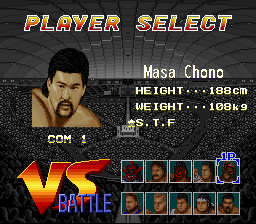
Player Select shows each wrestler's height, weight and signature move, and marks which side is you and which is the computer ("COM 1" here). After you choose, the VS screen shows both names, the time limit and the number of rounds. The time limit texts the game holds are 5, 10, 15, 45 and 60 minutes and unlimited, with 1 or 3 rounds. The original's "15分1本勝負" reads "15 Min 1 Round" in the patch.
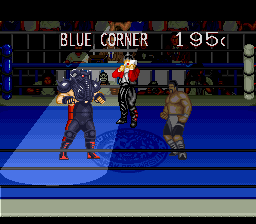
As the match begins, a line scrolls over the ring for each side: BLUE CORNER or RED CORNER, the wrestler's height in cm and weight in kg, and the name.
Health, recovery and POWER
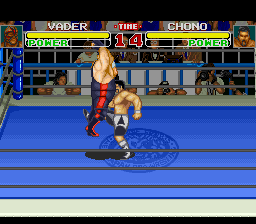
Each wrestler has three values, shown in the bars at the top.
| Value | What it does |
|---|---|
| Health | The yellow bar. Damage drains it. |
| Recovery pool | A hidden reserve that refills health while it lasts. |
| POWER | A gauge that fills as you fight; the bar turns red when it is high. |
A pinfall works once the defender's health is 0: with any health left he kicks out at once. The recovery pool only helps a defender who struggles (see Pins and submissions). A submission needs more: health 0, POWER low (below 1/8 of the full gauge) and the pool empty. A victim with health left escapes.
The TIME counter between the bars goes down as the match runs (seen at 14, then 12, in a 15-minute match). A pin shows the referee's count on screen as "COUNT 1, 2, 3".
Ways a match ends
| Result | How it happens |
|---|---|
| Pinfall | The referee counts 3 over a wrestler with no health left. "COUNT 3", then BLUE WIN (player 1) or RED WIN (player 2). |
| Submission | A hold on a downed opponent whose health, POWER and pool are all out. "GIVE UP", then the winner. |
| Ring out | A wrestler who stays outside the ring is counted out: 20 counts at about 2.5 seconds each (about 50 seconds), then "RING OUT" and the other side wins. |
| Time up | "TIME UP", then "DRAW GAME". There is no decision on health: even with the opponent at 1/8 health it is a draw. Unlimited time never runs out. |
One game second is about 51 frames, so a 15-minute match lasts about 12.75 real minutes. What a draw means in G1 Climax and how ROUND 3 works were not tested.
After the match
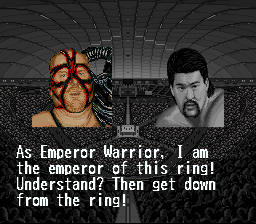
The winner and the loser each comment in a four-line text box. Each wrestler has a line for winning a match, one for losing and one for winning the tournament. This was seen for Liger, Hase and Vader; the rest follow the same order. The comments are written in the wrestlers' own voice in the first person; the foreign wrestlers' lines are broken Japanese in the original (all katakana), which the patch renders as plain, slightly stiff English.
Grappling
Every throw in this game starts with a tie-up, and the tie-up is won or lost in about a second. It is not a button-mashing contest: the first throw request wins, and what matters is when you press and, against the computer, the game level. All of this was read from the game's code and checked in an emulator.
The phases
Press X close to your opponent (within roughly 64 pixels sideways and 32 deep) to grab. The grabbed wrestler is forced into the tie-up too. The CPU grabs the same way, and grabbing first gives no edge.
| Phase | Length | What your buttons do |
|---|---|---|
| 1: reaching in | about 27 frames | Nothing: presses are ignored. |
| 2: moving into the tie-up | about 34 frames | Any A B X Y press gives you a penalty: your buttons are locked. |
| 3: the window opens | about 16 frames | One press does a throw (A, B, Y) or the Irish whip (X). Nothing changes on screen when it starts, about 1 second (61-62 frames) after the grab: the pose has been locked since about 8 frames into phase 2. |
| 4 and 5 | about 17 frames each | The same, then phases 4 and 5 repeat until someone throws. |
A grab at the game's own speed: press Play, or drag along the timeline (arrow keys work too). Grey is ignored, red is the penalty, green is the throw window. The pose stops changing about 36 frames in, long before the window opens at 62. The game updates the tie-up every second frame, so one step is two frames.
The directions, L and R do nothing during the tie-up and cause no penalty. A press in phase 4 clears a penalty, and the next press then works. Frame counts are at 60 frames a second and can be off by one or two frames.
Which throw you get depends on the button and on the wrestler: A, B and Y each have their own throw, from a table of four per wrestler. X is the same for everyone: it is an Irish whip, which sends the opponent into the ropes (see Controls). The strongest throws need a POWER gauge of at least 3/8 full; with less, the game swaps in a weaker move.
The CPU
The computer does not press buttons. At the start of each phase it rolls a die, and if the roll hits, it throws at once. The odds depend on the game level in Option Mode (Easy, Normal, Hard; the game starts on Normal). The rolls were confirmed over many random seeds on all three levels.
| When the CPU rolls | Easy | Normal | Hard |
|---|---|---|---|
| Start of phase 3 | 1 in 8 | 1 in 2 | always |
| Start of phase 4 | 1 in 4 | always | always |
| Start of phase 5 | 1 in 2 | always | always |
| Phase 4 again, and later | always | always | always |
The tie-up is decided by whoever asks first. If both ask on the same tick, the wrestler whose input the game reads second wins, and the player cannot choose which that is. On Hard, a press on the very first tick of phase 3 won 8 of 12 tests.
How to win it
| Your press | Easy | Normal | Hard |
|---|---|---|---|
| One press right at the start of phase 3 | about 94% | 75% | about 50% |
| One press later in phase 3 | 87.5% | 50% | 0% |
| One press in phase 4 | about 66% | 0% | 0% |
These chances are worked out from the CPU table above, not measured. They explain why the exchange feels hopeless above Easy: on Normal and Hard the CPU usually throws before the window has been open for long.
- Don't mash. A press during phase 2 is the penalty, even though the pose looks finished from about 8 frames in.
- Press once, about one second after the grab connects. Nothing on screen tells you the window has opened, so count it.
- If you pressed too early, press once in phase 4 to clear the penalty, then press again.
- Keep your POWER gauge up if you want the stronger throws.
How the CPU picks which throw it uses, and how much damage each throw does, are not documented yet.
Roster
The ten wrestlers, with the height, weight and signature move the Player Select screen shows for each. The figures and move names were read from the game's data; the names are the ones the patch uses. Click a heading to sort.
Secrets
Unlockables, codes and hidden screens, with how to reach them. The technical side (addresses, how each was found, what was searched) is in HIDDEN_CONTENT.md.
Multitap error screen
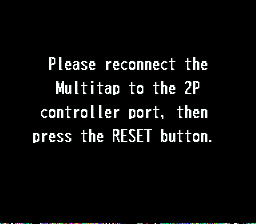
If the game finds a Super Multitap in controller port 1 at start-up, it stops on a text screen: reconnect the multitap to the 2P connector side, then press the RESET button. The patch translates it. It cannot come up in normal play.; seen only with the detection forced in an emulator.
Searched and not found
No button codes, debug menus, password or name entry, and no spare wrestler slot were found in the code. This is a search of the code, not a promise: a code read in an unusual way could have escaped it.
Japanese Glossary
Terms you'll see in the menus and on screen of the original Japanese game. The English translation shows the English terms.
| Japanese | Meaning | On screen in the translation |
|---|---|---|
| 青コーナーao kōnā | Blue corner | BLUE CORNER |
| 赤コーナーaka kōnā | Red corner | RED CORNER |
| 15分1本勝負jūgo-fun ippon shōbu | A one-fall match with a 15-minute limit | 15 Min 1 Round |
| 無制限museigen | No limit | Unlim. |
| 公認kōnin | Authorized (by the promotion) | Authorized by NJPW |
| 監修kanshū | Supervision | Supervised by S. Sakaguchi |
| 勝ち抜きモードkachinuki mōdo | Knockout mode: win to go on | G1 CLIMAX description: "knockout tournament" |
| 皇帝戦士kōtei senshi | Emperor Warrior, a nickname | Emperor Warrior |
| 破壊王hakai-ō | Destruction King, a nickname | Destruction King |
Q&A
Is there an English version?
Not from the publisher: the game was only released in Japan. This guide was written alongside an English fan translation, released as a patch for your own copy of the game.
Why are some names shortened?
The name box on the Player Select and VS screens holds 13 letters. Jushin Liger, Great Muta, T. Fujinami, S. Hashimoto and Masa Chono are the shortened forms; the roster gives the Japanese names.
Credits and Legal
This guide is a non-commercial fan project, not affiliated with or endorsed by Varie, New Japan Pro-Wrestling or any other rights holder. Shin Nippon Pro Wrestling: Chou Senshi in Tokyo Dome and its names, characters and trademarks belong to their owners.
The text is written in our own words from play, the game's code and the sources below. It contains no scans or images from any printed guidebook. The screenshots are from the English fan translation.
Sources: the game itself, and the No-Intro database (the cartridge's name and checksum).
AI assisted with this guide.
The guide text is shared under Creative Commons Attribution-ShareAlike 4.0 (CC BY-SA 4.0; see LICENSE). You're free to share and adapt it, as long as you credit this guide and share alike.
Contributing
The full move list, throw damage and the CPU's choice of throw are not covered yet. Corrections and additions are welcome: open an issue on the project's GitHub page, especially for the other wrestlers' moves and the options not tested.